Note
Go to the end to download the full example code.
Sparse Text Classification with Vocabulary Limits#
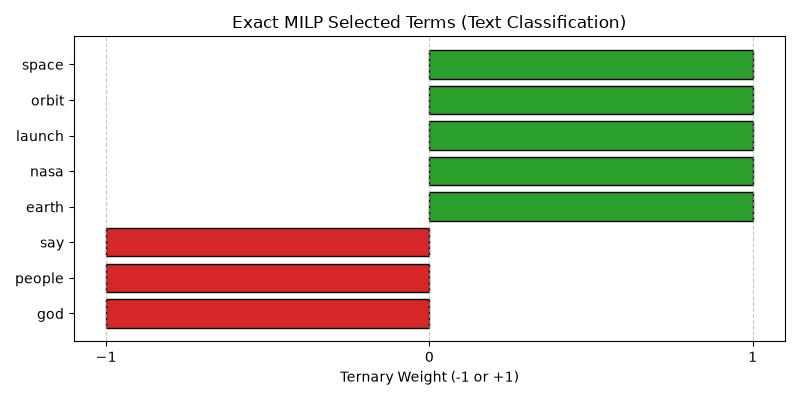
Shows how to pair TfidfVectorizer with TlmMilpClassifier by constraining
vocabulary dimension to prevent exponential MILP solver time, visualizing the
resulting ternary text weights.
import matplotlib.pyplot as plt
import numpy as np
from sklearn.datasets import fetch_20newsgroups
from sklearn.feature_extraction.text import TfidfVectorizer
from sklearn.pipeline import Pipeline
from tlmnet import TlmMilpClassifier

# Fetch binary text dataset subset
categories = ["alt.atheism", "sci.space"]
newsgroups = fetch_20newsgroups(
    subset="train", categories=categories, remove=("headers", "footers", "quotes")
)

# Constrain vocabulary to top 25 terms to keep MILP dimension tractable
pipeline = Pipeline(
    [
        (
            "tfidf",
            TfidfVectorizer(max_features=25, stop_words="english", sublinear_tf=True),
        ),
        ("tlm", TlmMilpClassifier(max_features=8, C=1.0)),
    ]
)

pipeline.fit(newsgroups.data, newsgroups.target)

# Retrieve selected words and their discrete ternary weights
feature_names = pipeline.named_steps["tfidf"].get_feature_names_out()
weights = pipeline.named_steps["tlm"].coef_

# Filter down to only the non-zero features selected by the MILP solver
mask = weights != 0
active_words = feature_names[mask]
active_weights = weights[mask]

# Sort by weight for cleaner plotting
sort_idx = np.argsort(active_weights)
active_words = active_words[sort_idx]
active_weights = active_weights[sort_idx]

# Plot the ternary weights
plt.figure(figsize=(8, 4))
colors = ["#d62728" if w < 0 else "#2ca02c" for w in active_weights]
plt.barh(active_words, active_weights, color=colors, edgecolor="black")

plt.xlabel("Ternary Weight (-1 or +1)")
plt.title("Exact MILP Selected Terms (Text Classification)")
plt.xticks([-1, 0, 1])
plt.grid(axis="x", linestyle="--", alpha=0.7)
plt.tight_layout()
plt.show()
Total running time of the script: (0 minutes 10.650 seconds)